Palau Güell: A Glimpse into Gaudí's Early Work and Genius
Palau Güell is a magnificent example of domestic architecture in the context of Art Nouveau. Located in the heart of Barcelona, this urban palace was one of the first important commissions Antoni Gaudí received at the start of his career. Commissioned by Eusebi Güell, an industrialist, politician, and patron of the arts, Palau Güell served as an extension of the family home on La Rambla. Today, it stands as a testament to Gaudí's innovative conception of space and light and is a must-see attraction for tourists visiting Barcelona.
Innovative Approach to Architecture and Design
Palau Güell is a stunning example of Gaudí's innovative approach to architecture and design. Built between 1886 and 1890 for Eusebi Güell, the urban palace is a testament to Gaudí's ability to create functional spaces that were both beautiful and practical.
Ground Floor
The ground floor of Palau Güell served as the entrance to the palace and was also used for various services. The entrance was through double doors from the street. This floor accommodated several essential areas: the coach house for carriages, a storage space for farming products, the doorman's quarters connected to the stable via a spiral staircase, a street-facing booth allowing the doorman to observe the surroundings, and a servants' staircase facilitating access to the other floors.
Main Facade
One of the most striking features of Palau Güell is its main facade. The building's exterior is adorned with intricate stone and wrought iron work, showcasing Gaudí's mastery of traditional materials. The main entrance is particularly impressive, with its parabolic arch and ornate iron gates. The facade features two parabolic entrance arches closed by two huge wrought iron gates, and wrought iron adorns the outer railings of the windows and embellishes the coat of arms of Catalonia, topped with a helmet featuring a phoenix.
The facade is built entirely of Garraf limestone and is divided into three levels. On the first two levels, the stone is saw cut and polished, while on level three it was treated with a punch. On level two, the main floor's bay window projects over the street.
Interior Spaces
Inside, Palau Güell is a labyrinth of rooms and spaces, each designed with a specific purpose in mind. The building was intended to serve as both a family home and a venue for the Güell family's cultural and social events. As such, Gaudí created a variety of spaces that could accommodate both intimate family gatherings and large public receptions.
Central Hall
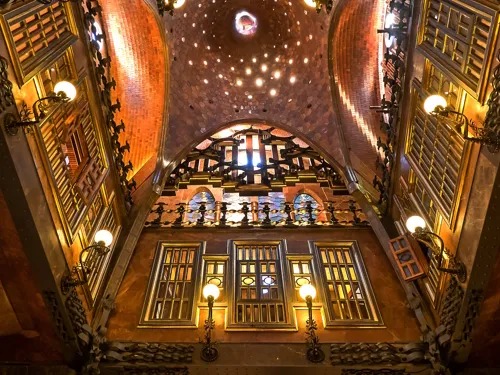
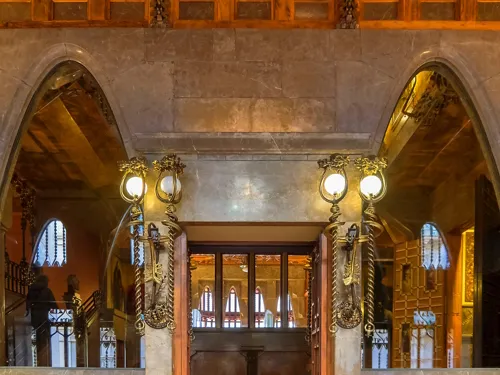
One of the most impressive spaces in Palau Güell is the central hall. This large room was designed to host concerts and other performances and features a stunning domed ceiling with small openings that allow natural light to filter in. The ceiling is decorated with intricate patterns and motifs, creating a beautiful play of light and colour on the walls and floors. The central hall also boasts a grand staircase leading up to the upper floors of the building, adding to the sense of grandeur and elegance.
Roof Terrace
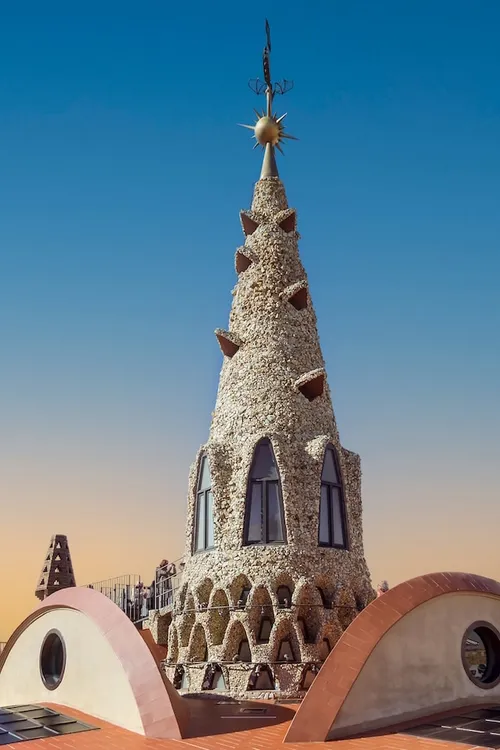
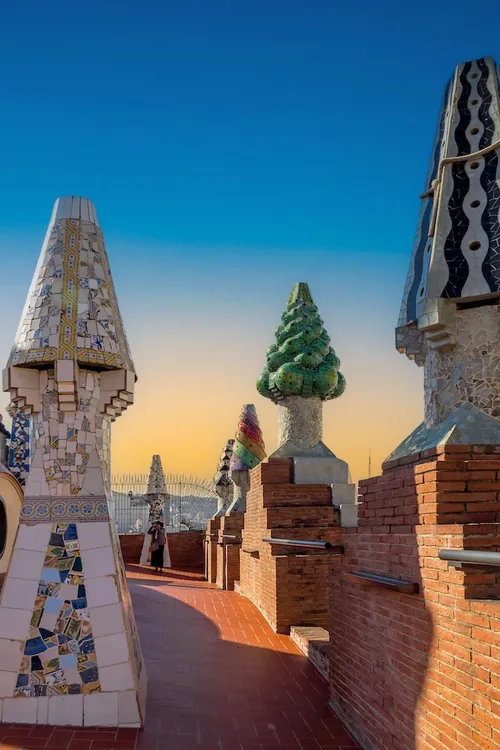
On the roof terrace of Palau Güell, Antoni Gaudí turned traditional chimneys into genuine sculptures, with bases, stacks, and caps in fantastic shapes. There are twenty chimneys altogether. In the middle of them is the 15-metre high spire, which tops the dome of the central hall and is covered in an original recycled stone.
The distinctive chimneys are so typical of Gaudí's style and were installed on the roof in 1895. They also serve to ventilate the house. The rooftop terrace offers visitors a unique perspective on Gaudí's innovative approach to architecture and design.
Innovative Use of Light
Another notable feature of Palau Güell is its use of light. Antoni Gaudí was known for his innovative approach to lighting, and this is evident throughout the building. The central hall features a series of stained glass windows that allow natural light to flood the space. Elsewhere in the building, Gaudí used skylights and other clever design features to bring light into even the darkest corners.
Traditional Materials
In addition to its innovative use of space and light, Palau Güell is also notable for its use of traditional materials. Gaudí was a master at working with stone, wood, wrought iron, pottery, glass, and other materials, and this is evident throughout the building. From the intricate stone carvings on the facade to the beautiful wrought iron work on the balconies and staircases, Palau Güell is a showcase of Gaudí's skill as an architect and designer.
The History of Palau Güell
Palau Güell was commissioned by Eusebi Güell and served as the home of the Güell i López family until they moved to Park Güell. Over the years, Palau Güell has been recognised for its architectural and historical significance. In 1969, it was declared a historical-artistic monument by the Spanish Government. In 1984, it was designated a Cultural Asset of National Interest by the Catalan Government and a World Heritage Site by UNESCO.
Today, Palau Güell stands as a testament to Antoni Gaudí's innovative approach to architecture and design. As an early work, the building contains the essence of Gaudí's later works and is fundamental to understanding his architecture. In the words of Antoni Gaudí himself, "originality consists in returning to the origin."
How to Get to Palau Güell
Palau Güell is located in the heart of Barcelona's Raval district and is easily accessible by public transportation. You'll find it just a short distance away from some of the city's most important attractions such as La Rambla, Plaça Catalunya, and the Gothic Quarter.
The best way to get to Palau Güell depends on your location and personal preferences. If you're staying in central Barcelona, you can easily walk to the palace. Alternatively, you can take the metro to Liceu station on line 3 (L3) or Drassanes station on line 3 (L3), both of which are a short walk away.
Address: Carrer Nou de la Rambla, 3-5, 08001 Barcelona